Finding of the Holy Cross Parish (Chudniv)
m. Chudniv · Patronal feast: 3 May
About the parish
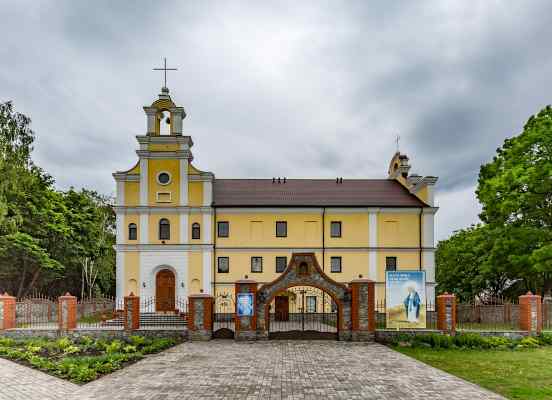
The church and monastery in Chudniv were established in the second half of the eighteenth century through an endowment by Prince Sanguszko, Court Marshal of the Grand Duchy of Lithuania. In 1787, the friars welcomed the Polish king, Stanisław August, who visited the monastery on his way to Kaniv to meet Empress Catherine II. According to the chronicle, the king attended Holy Mass and dinner and left a generous donation for the town’s poor.
The Franciscan house in Chudniv was initially a dependent house. In 1789, it was raised to the status of a convent under a guardian. Unlike other Franciscan houses of the Ruthenian Province, it had only a few friars. In 1790, there were just four friar-priests, who developed the monastery library and preached.
In 1800, the friars began running a small agricultural school at the monastery. Their number had grown to ten by 1818. In 1831, the religious studies programme was transferred from Dubno to Chudniv because half of the Dubno monastery had been assigned to a hospital. Unfortunately, the programme had little time to develop, since the Chudniv convent was suppressed in 1832. The reason was its small number of friars: after 1812, there were fewer than eight, which under russian law was sufficient grounds to close the house.
Under the occupying Soviet regime, the church and monastery were dismantled almost to their foundations. Only one wall of the former monastery survived.
The parish community in Chudniv was re-established only in 1990. At first, parishioners gathered for Holy Mass in an ordinary house. When part of the former monastery building was returned, they began gathering there for prayer. Today, the Chudniv parish has approximately sixty practising Catholics.